

Outcome
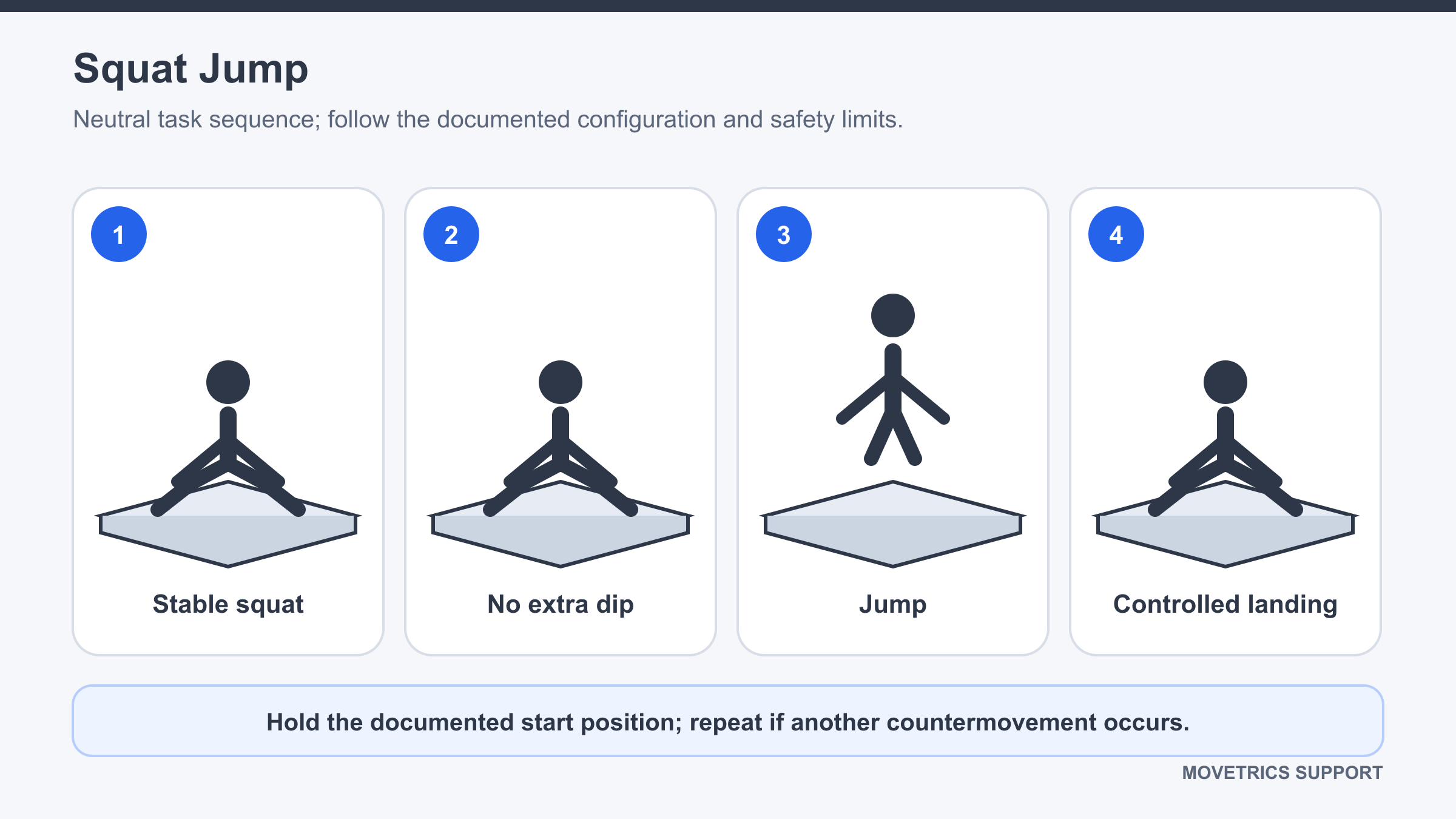
Record one vertical jump that starts from a stable held squat without another downward movement before take-off.
Applies to
Use the Squat Jump examination tile and an approved adjacent-plate configuration. Use the same agreed squat depth and instructions when comparing trials.
Before you begin
- Confirm the plates are stable, unloaded, and matched to the selected configuration.
- Clear the landing area and arrange a spotter if required.
- Select the correct project, Subject, configuration, and Squat Jump examination.
- Agree a comfortable squat depth, a still hold, footwear, and arm position.
- Cue the person: “Lower to the agreed squat position and hold still. On the cue, jump straight up without dipping again. Land in the same place and stand still.”
Steps
- Select the Squat Jump tile to open Measure.
- Keep both plates completely unloaded during tare.
- When prompted, ask the person to step on with one foot on each configured plate.
- Ask the person to lower to the agreed squat depth and become still.
- Confirm the feet remain fixed, the body is balanced, and no downward movement continues.
- Give the start cue only after the hold is stable.
- The person jumps vertically without dipping first, lands on the same plates, and remains still.
- Wait until the wizard permits the person to step off.
- In View, check the trace and observed movement for a stable hold followed directly by upward movement and take-off.
- Record squat depth, hold instruction, arm position, footwear, visible countermovement, and any reason for repetition.
You should now see
One saved Squat Jump trial with a stable held start, no visible extra downward movement, a clear jump, and a controlled landing.
Stop or repeat when
- Tare is disturbed or the person cannot hold the starting position.
- The person changes depth, dips again before jumping, moves a foot, or uses a different arm action.
- Balance is lost, landing leaves a plate, or the task becomes unsafe.
- The saved trace does not match the observed sequence.
If it does not work
Clarify the starting depth and cue, allow recovery, and repeat the full examination from tare. Do not edit or reinterpret a trial to hide a visible countermovement.