

Outcome
Describe a Movetrics result at the level supported by the recorded task, trace, and approved documentation.
Applies to
Use these boundaries when reviewing, teaching from, comparing, or communicating any Movetrics result.
Before you begin
- Confirm the trial is usable and the setup, protocol, and notes are complete.
- Review the trace, table, graph, units, and configuration before reading generated text.
- Check whether the intended comparison uses equivalent conditions.
Steps
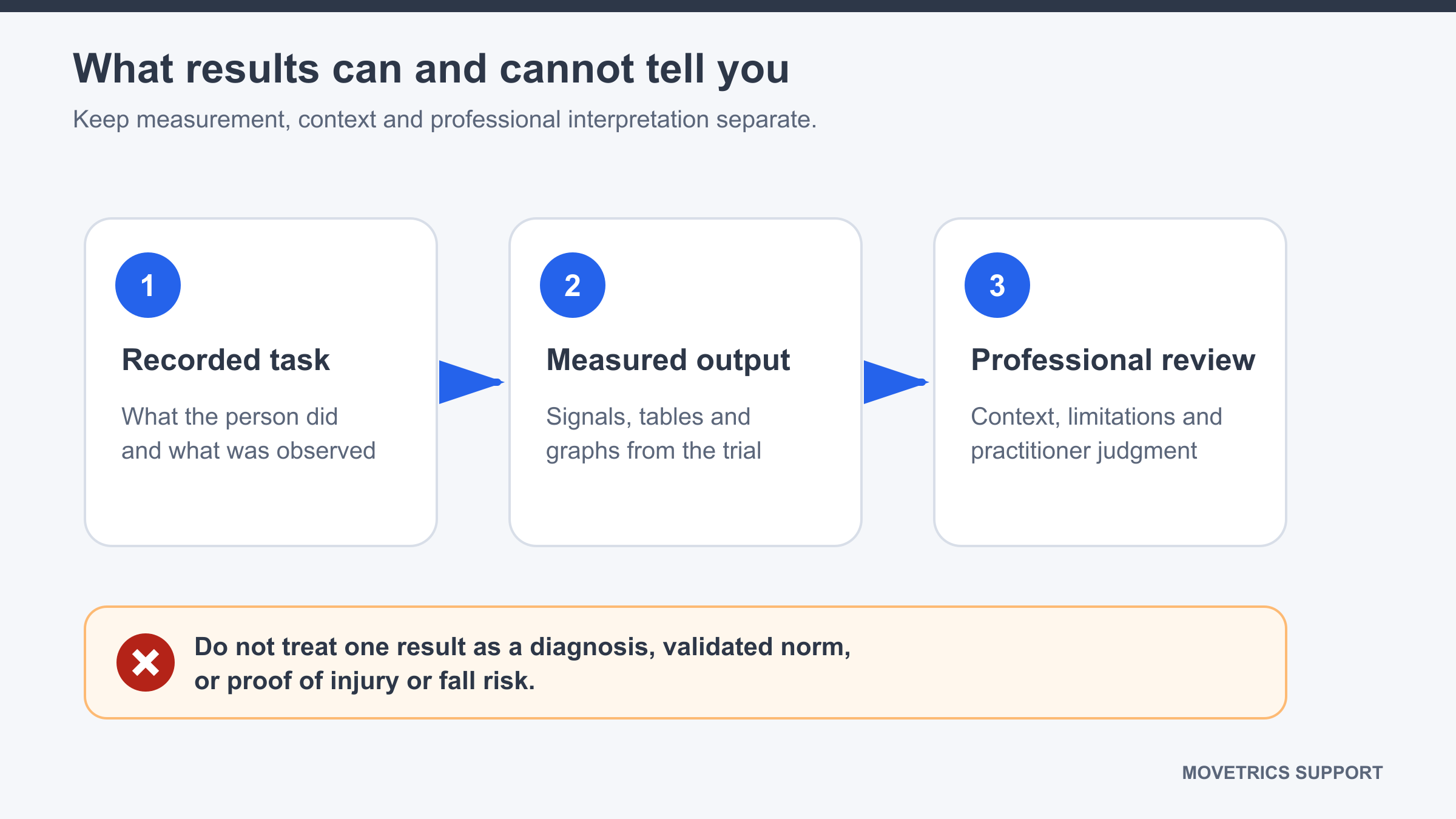
- Begin with what happened: name the task, configuration, person instructions, and relevant conditions.
- Describe only values and patterns shown in the reviewed output, using their displayed names and units.
- State the platform assignment from the selected configuration rather than assuming left and right.
- When comparing trials, confirm protocol, setup, instructions, footwear, equipment, and review criteria are equivalent.
- Separate an observed difference from its possible explanation. The measurement alone does not establish a cause.
- Do not treat displayed colours or ranges as validated reference values unless an approved source for that exact use is supplied.
- Do not turn a result into a clinical conclusion, treatment decision, or personal risk prediction.
- Do not claim regulatory status, system accuracy, or agreement with another system unless current approved evidence supports the exact statement.
- Use qualified practitioner judgment and other relevant information for decisions beyond the recorded measurement.
You should now see
A factual description that states the task and measured output, separates observation from interpretation, and makes its limitations clear.
Stop or repeat when
- A conclusion depends on an unverified formula, reference range, threshold, or comparison.
- A table, graph, unit, trace, or text statement conflicts with another part of the same examination.
- The trial setup or quality is uncertain.
If it does not work
Reduce the statement to the verified task and displayed measurement, or leave the result uninterpreted until the missing evidence is available. Never fill an evidence gap with generated text.